
In 2025, the Church of Jesus Christ of Latter-day Saints, (LDS Church) sent out approximately 78,596 full-time teaching missionaries[1] to win converts to the Church. But what type of gospel message do they have? If the missionaries are unaware of the truth themselves, then perhaps it is time to open their eyes?
This study has the potential of bringing about a life changing experience for the missionaries, in which,
“… the truth will set them free.”[2]
So, get ready to ask the LDS missionaries some tough questions, and also provide them with some solid, well documented answers, from sources they can trust: The Joseph Smith Papers, LDS.org and BYU Studies.
First Question for the Missionaries:
Do you know that because Joseph Smith had not followed his instructions[3] and set the golden plates down on the ground, he was hurled back upon the ground with great violence and ended up coming home empty handed?
Yes, or no?
Joseph Smith’s mother, Lucy Mack Smith, wrote about this event in her diary which is available @ Josephsmithpapers.org:
“in the moment of excitement; he laid them down very carefully to cover the box, lest some one might happen that way and get whatever there might be remaining in it; and, after covering it, he turned around to take the record again, but behold it was gone … instead of getting them, as he anticipated, he was hurled back upon the ground with great violence. When he recovered, the angel was gone, and he arose and returned to the house weeping for grief and disappointment. Being aware that we expected him to bring the plates home with him, he was greatly troubled.” (Lucy Mack Smith History 1845, p. 88)
Second Question for the Missionaries:
Do you know that Joseph Smith was told by the personage guarding the plates to bring his brother Alvin with him to get the golden plates in 1824, but Alvin died on November 19th, 1823?
Yes, or no?
This is documented in Joseph Knight’s account which is available @ BYU Studies:
“And he opened the Box and Behold the Book was there. He took hold of it to take it out again and Behold he Could not stur the Book any more then he Could the mountin. He exclaimed “why Cant I stur this Book?” And he was answered, ‘you cant have it now.’ Joseph says ‘when can I have it?” The answer was the 22nt Day of September next if you Bring the right person with you. Joseph says, ‘who is the right Person?’ The answer was ‘your oldest Brother.’”
But before September Came his oldest Brother Died.” (Joseph Knight’s Recollection of Early Mormon History Copyright BYU Studies 1976, p. 4)
Early American Folklore, Was This the Foundation of Joseph Smith’s Stories?
Read the following quote from the Joseph Smith 1826 Glass Looking Trial to the missionaries:
“… Smith looked in hat while there, and when very dark, and told how the chest [of treasure] was situated. After digging several feet, struck upon something sounding like a board or plank. Prisoner would not look again, pretending that he was alarmed the last time that he looked, on account of the circumstances relating to the trunk being buried came all fresh to his mind; that the last time that he looked [in his hat], he discovered distinctly the two Indians who buried the trunk; that a quarrel ensued between them, and that one of said Indians was killed by the other, and thrown into the hole beside of the trunk, to guard it, as he supposed.” (Jonathan Thompson Testimony, Miss Pearsall Account, 1826 Glass Looking Trial)
Then read the following quote from: Money Digging Folklore and the Beginnings of Mormonism: An Interpretive Suggestion—Marvin S. Hill, BYU Studies:
“That the Chase account appears in a collection of testimonials published by an anti-Mormon while the Knight narrative comes from a faithful Latter-day Saint whose statement was not published until very recently suggests that the anti-Mormon material cannot be lightly dismissed because of its origin. The anti-Mormon statements have to be checked against what is admitted by the Mormons themselves. Willard Chase very likely heard his story from Joseph Smith, Sr., as he reported this is further evidenced by an independent account published by Fayette Lapham in 1870 of an earlier interview with Joseph Smith, Sr., as to the origin of the golden plates. This report corresponds closely in some respects to what Knight and Chase recounted.”
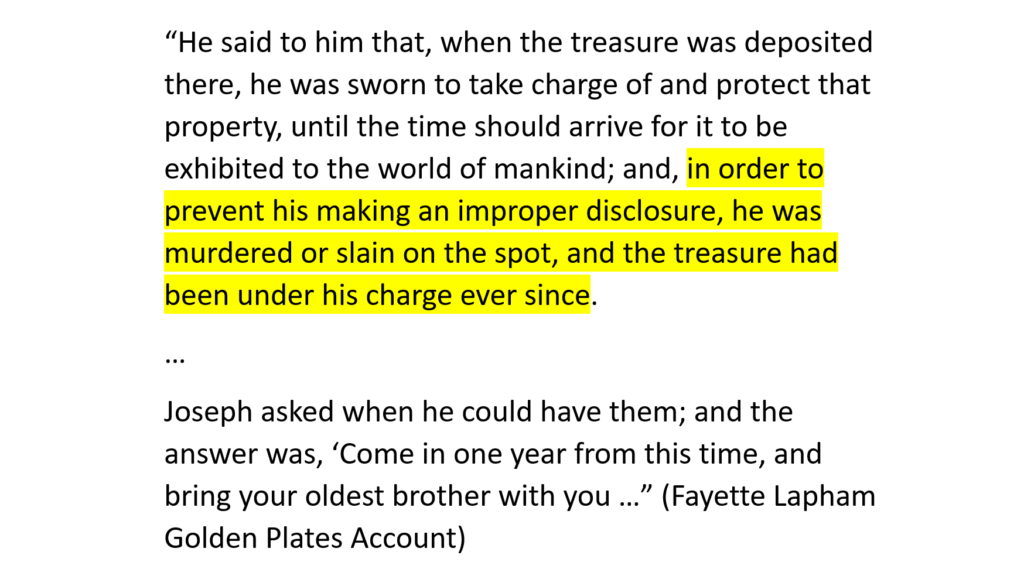
“… he was murdered or slain on the spot and the treasure [golden plates] had been under his charge ever since.” (Fayette Lapham Golden Plates Account)
The account by Fayette Lapham answered the question of how,
“… the angel Moroni,”[4]
became the guardian of the golden plates.
However, the story of Moroni watching over the golden plates is basically the same as the story of a treasure guardian documented in Joseph Smith’s 1826 Glass looking Trial.
Sound Answers for the Missionaries:
Tell the missionaries:
The foundation of the restored gospel of Jesus Christ is basically the same as a money digging account from Joseph Smith’s 1826 Glass Looking Trial.
If the missionaries show any willingness to do more research into early LDS history, from LDS.org and the Joseph Smith Papers, then schedule a day to go through the 1823-bedroom dream study with them:
■ Joseph Smith 1823 Bedroom Dream — Rich Kelsey
Other articles to research after that:
■ “Moroni” Accounts with Rich Kelsey’s Observations
■ Ten LDS Plot holes — Rich Kelsey
Full Article Index LDS Articles
Endnotes:
[1] (Statistical Report, 2025)
[2] “So Jesus was saying to those Jews who had believed Him, ‘If you continue in My word, then you are truly My disciples; and you will know the truth, and the truth will set you free.'” (John 8:31-32, NASB)
[3] “On the 22d of September, he must repair to the place where was deposited this manuscript, dressed in black clothes, and riding a black horse with a switch tail, and demand the book in a certain name, and after obtaining it, he must go directly away, and neither lay it down nor look behind him.” (Willard Chase Account)
Also:
“… he kneeled down, <&> asked the Lord, why the record had been taken from him; whereupon the angel of the Lord appeared to him, and told him, that he had not done, as he had been commanded: in a former revelation he had been commanded, not to lay the plates down, or put them for a moment out of his hands, until he got into the house and deposited them in a chest or trunk, with a good lock and key …” (Lucy Mack Smith History 1845, p. 88)
[4] “Joseph’s 1832 history recounts that the Lord ‘shewed unto me a heavenly vision for behold an angel of the Lord came and stood before me.’ These and other early accounts referred to this messenger simply as ‘the angel.‘” (Church History / Angel Moroni, church-of-jesus-christ.org)