Book of Moses Chapters 1-8:
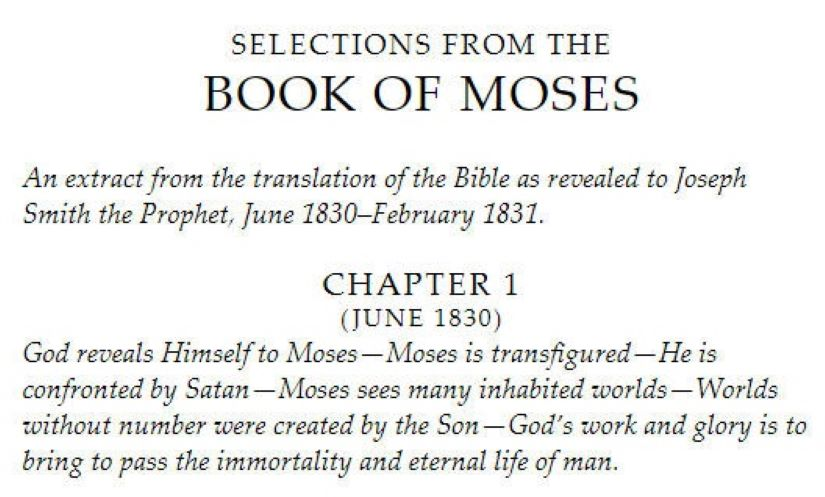
In June 1830, Joseph Smith, the founding prophet of The Church of Jesus Christ of Latter-day Saints, set out to correct[1] the King James Version of the Bible. Smith started by adding an opening chapter to Genesis: The Book of Moses Chapter 1.
Three thousand, four hundred, and twenty-two words were added to Genesis up until Genesis Chapter 6:13, which is where the Book of Moses ends. That almost doubles the word-count of Genesis up to that point in the King James Version of the Bible. This supposed restored work of Moses is published in the Pearl of Great Price, which is LDS scripture.
The Book of Moses defines doctrines[2] that set The Church of Jesus Christ of Latter-day Saints apart from other churches. While there is no manuscript evidence to support the claim that much of what was recorded by Moses in the first six chapters of Genesis had been taken from Moses’ original record, we do have a statement on this subject from the Book of Moses itself.
Book of Moses 1:41:
“And in a day when the children of men shall esteem my [God’s] words as naught and take many of them from the book which thou [Moses] shalt write, behold, I will raise up another like unto thee; and they shall be had again among the children of men—among as many as shall believe.” (Moses 1:41)
In the passage above, the one like unto Moses who will restore the words which men will take from the book Moses, is Joseph Smith; this is confirmed by a similar prophecy found in the last chapter of Genesis from the Joseph Smith Translation of the Bible:
“And that seer will I bless, and they that seek to destroy him shall be confounded; for this promise I give unto you; for I will remember you from generation to generation; and his name shall be called Joseph, and it shall be after the name of his father; and he shall be like unto you; [Moses] for the thing which the Lord shall bring forth by his hand shall bring my people unto salvation.” (Genesis 50:33, JST)
Out of all the Bibles in the world, only the Joseph Smith Translation contains this prophecy about Joseph Smith; conventional translations of Genesis end at Chapter 50:26.
There is no manuscript evidence to verify that the seventy-five word prophecy about Joseph Smith in Genesis 50:33 was written before Joseph Smith dictated the Book of Moses to his scribe. So, in order to determine whether the words added to Genesis are indeed the restored words of Moses, a careful examination of those words are in order.
Changes to the King James Version:
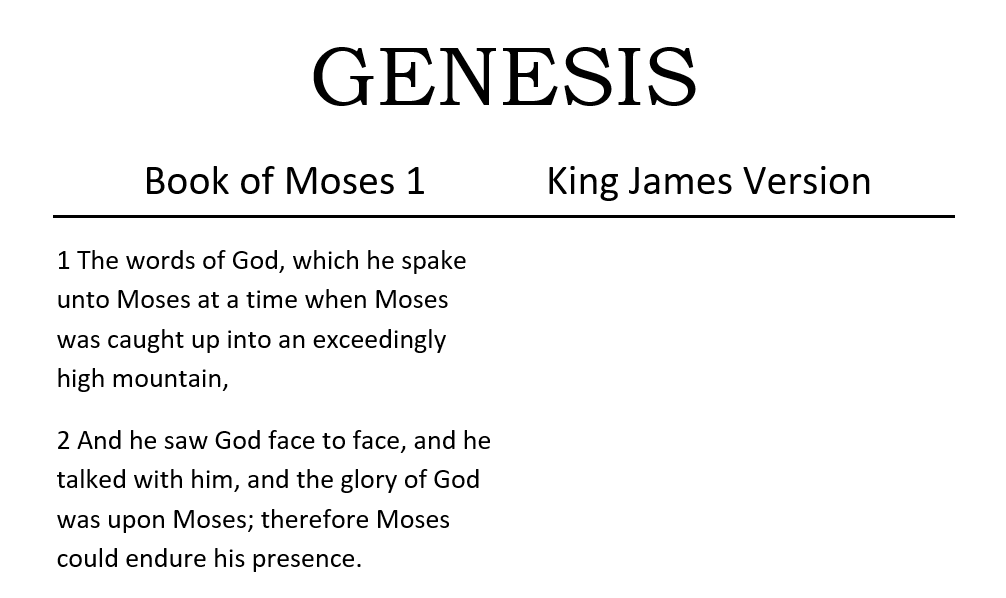
The opening chapter to the Book of Moses has one-thousand, five-hundred and thirteen words in it; this opening chapter to Genesis is not found in any other Bible on the face of the planet. The LDS Church maintains that this chapter was taken from Moses’ original record and later restored by their founding Prophet, Joseph Smith. Yet many of the phrases found in Moses Chapter 1 reveal that the phrases did not come from Moses’ hand.
For example, the following phrase:
“… mine Only Begotten …”
is not found in Moses’ accepted record, neither is the phrase found in the entire Old Testament, yet it is found six times in Moses Chapter 1, here is an example:
“And I have a work for thee, Moses, my son; and thou art in the similitude of mine Only Begotten; and mine Only Begotten is and shall be the Savior, for he is full of grace and truth …” (Moses 1:6)
Here is another example:
“And by the word of my power, have I created them, which is mine Only Begotten Son, who is full of grace and truth.” (Moses 1:32)
Notice the similarity of Moses’ supposed lost record and what is written in the New Testament Gospel of John:
“And the Word was made flesh, and dwelt among us, (and we beheld his glory, the glory as of the only begotten of the Father,) full of grace and truth.” (John 1:14, KJV)
The saying,
“… full of grace and truth“
is also not found in found in Moses’ accepted record, neither is the phrase found in the entire Old Testament. This is noteworthy because since descriptions of Jesus Christ as,
“… mine Only Begotten …”
and,
“… full of grace and truth …”
are nowhere to be found in all of the accepted Old Testament books of the Bible, it casts suspicion on the authenticity of any supposed restored book from the Old Testament that contains such language.
More Changes to the King James Version:
The first verse of the second chapter of the Book of Moses has fifty-two more words in it than in Genesis Chapter 1 from The King James Bible:
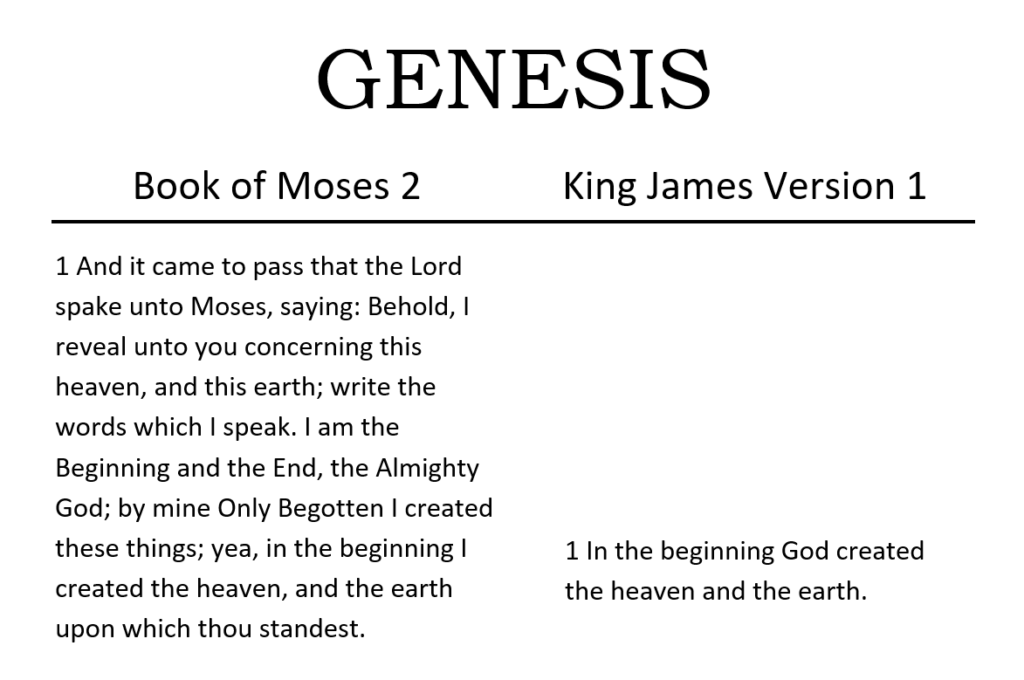
“And it came to pass that the Lord spake unto Moses, saying: Behold, I reveal unto you concerning this heaven, and this earth; write the words which I speak. I am the Beginning and the End, the Almighty God; by mine Only Begotten I created these things; yea, in the beginning I created the heaven, and the earth upon which thou standest.” (Moses 2:1)
Compare to:
“In the beginning God created the heaven and the earth.” (Genesis 1:1, KJV)
Instead of the opening words of Moses’ record spelling out,
“In the beginning God created …” (Genesis 1:1, KJV)
It is written,
“And it came to pass …” (Moses 2:1)
Then, a saying which is found in the second to the last, and also the very last chapter of The Book of Revelation is included in Moses’ supposed original words:
“And he said unto me, It is done. I am Alpha and Omega, the beginning and the end. I will give unto him that is athirst of the fountain of the water of life freely.” (Revelation 21:6, KJV)
“I am Alpha and Omega, the beginning and the end, the first and the last.” (Revelation 22:13, KJV)
The problem: Nowhere in Moses’ known writings, or in the entire Old Testament, or in the first 65 books of the Bible for that matter, is Jesus described as,
“… the beginning and the end.”
Another thing to consider: Joseph Smith had access to the King James Version of the Bible, which begs the question: Was it Joseph Smith who took a description of Jesus from the last book of the Bible and attributed the same description of Jesus as coming from the Old Testament Prophet Moses?
Again, no manuscript evidence is available to document that Moses originally wrote the fifty-two words which Joseph Smith added to Genesis 1:1; also known as Moses 2:1 in The Pearl of Great Price.
Book of Moses 4 vs. Genesis Chapter 3:
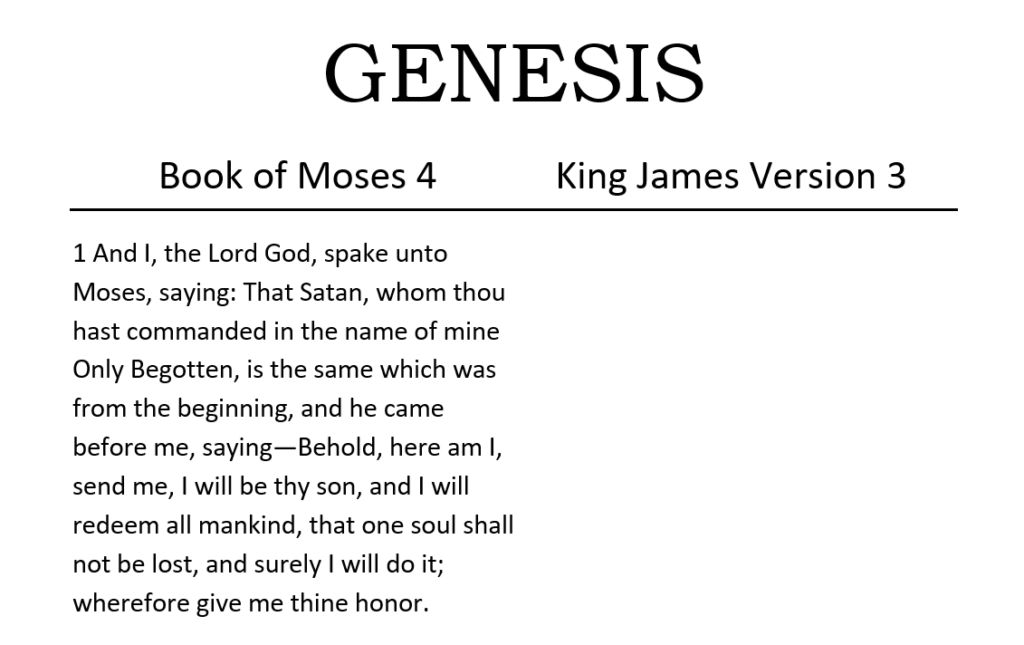
One hundred and eighty-nine words were added to God’s word in the Book of Moses Chapter 4, before Genesis Chapter Three, verse 1, in the King James Version:
1 And I, the Lord God, spake unto Moses, saying: That Satan, whom thou hast commanded in the name of mine Only Begotten, is the same which was from the beginning, and he came before me, saying—Behold, here am I, send me, I will be thy son, and I will redeem all mankind, that one soul shall not be lost, and surely I will do it; wherefore give me thine honor.
2 But, behold, my Beloved Son, which was my Beloved and Chosen from the beginning, said unto me—Father, thy will be done, and the glory be thine forever.
3 Wherefore, because that Satan rebelled against me, and sought to destroy the agency of man, which I, the Lord God, had given him, and also, that I should give unto him mine own power; by the power of mine Only Begotten, I caused that he should be cast down;
4 And he became Satan, yea, even the devil, the father of all lies, to deceive and to blind men, and to lead them captive at his will, even as many as would not hearken unto my voice.
Problems With Moses Chapter 4:1-4
Verse 1 contains a story about Satan coming before God and offering to redeem all of mankind without one soul being lost. What are the odds that there would be no reference to such a significant historical event pertaining to the redemption of mankind, found in any other books of the King James Bible, or in the pages of any other Bible on the planet, except in the supposed Book of Moses?
The record gets worse: verse 2 contains part of an ending to the Lord’s Prayer that is not found in the best Bible manuscripts:
“… For thine is the kingdom, and the power, and the glory, for ever. Amen.” (Matthew 6:13, KJV)
The reason the questionable ending to the Lord’s Prayer is not in trusted manuscripts, is because Jesus never spoke those words, they were added later,
“… by transcribers to make the text of the discourse harmonise with the liturgies.”[3]
Also, verse 3 contains a doctrinal term:
“… agency of man …”[4]
that doctrinal term was used in Joseph Smith’s day; but it was never spoken by Moses. Neither is the term found in the entire Old Testament.
And verse 4 alludes to a saying from Jesus Christ found in the New Testament:
“Ye are of your father the devil, and the lusts of your father ye will do. He was a murderer from the beginning, and abode not in the truth, because there is no truth in him. When he speaketh a lie, he speaketh of his own: for he is a liar, and the father of it.” (John 8:44, KJV)
Obviously, Moses did not have the King James New Testament in his possession, yet Joseph Smith did! If there is still any reasonable doubt in your mind that Joseph Smith took sayings from the New Testament and attributed those same sayings to Moses’ record, the following sections should eliminate any of that doubt.
Example of Obvious Plagiarism:
The following passage was supposedly spoken by Noah and recorded by Moses, but it sounds almost exactly like what the Apostle Peter said to the emerging New Testament Church on the Day of Pentecost:
“Believe and repent of your sins and be baptized in the name of Jesus Christ, the Son of God, even as our fathers, and ye shall receive the Holy Ghost …” (Moses 8:24)
Compare to Acts 2:38:
“Then Peter said unto them, Repent, and be baptized every one of you in the name of Jesus Christ for the remission of sins, and ye shall receive the gift of the Holy Ghost.” (Acts 2:38, KJV)
The problem: the words added to Genesis in Moses 8 sound like they came from someone who was familiar with the King James Version of the New Testament Book of Acts.
What makes matters worse: nowhere in Moses’ accepted works does Moses speak of people repenting and being baptized in the name of Jesus Christ for the remission of sins. Baptizing people in the name of Jesus Christ is also not mentioned in any other books in the entire Old Testament.
The Holy Ghost Was Given After Christ’s Death, Burial, Resurrection & Ascension:
“For John truly baptized with water: but ye shall be baptized with the Holy Ghost not many days hence.” (Acts 1:5, KJV)
Christ’s own disciples did not have the Holy Ghost when Jesus spoke those words. They received the Holy Spirit on the day of Pentecost, when the early Church was first formed. Not in 2,500 B.C. like the people in the Book of Moses supposedly did.
The record gets even worse: on this subject it is also written,
“Nevertheless I tell you the truth; It is expedient for you that I [Jesus Christ] go away: for if I go not away, the Comforter will not come unto you; but if I depart, I will send him unto you.” (John 16:7, KJV)
The Joseph Smith Translation of the New Testament reads exactly the same as the King James Version, which speaks of the Holy Spirit being given after Christ’s ascension.
The problem: even the Joseph Smith Translation of the New Testament claims that the Holy Spirit,
“… will not come unto you …” (John 16:7, JST)
until after Christ departs; in other words, after Jesus ascends to heaven. So why would this be Noah’s message to people long before Jesus Christ was even born:
“Believe and repent of your sins and be baptized in the name of Jesus Christ, the Son of God, even as our fathers, and ye shall receive the Holy Ghost, that ye may have all things made manifest; and if ye do not this, the floods will come in upon you; nevertheless they hearkened not. (Moses 8:24)
Stating the Obvious:
Claiming that Moses is the true author of this supposed restored record gives credibility to the teachings of The Church of Jesus Christ of Latter-day Saints. However, the Book of Moses is nothing more than a poorly crafted forgery, with spurious content falsely attributed to an ancient holy man.
Other articles of interest:
■ Book of Moses Changes — Rich Kelsey
■ Book of Moses Anachronisms — Rich Kelsey
Full Article Index LDS Articles
Endnotes:
1 The Inspired Version of the Bible, also known as the Joseph Smith Translation, was first published in 1867 by the Reorganized Church of Jesus Christ of Latter-Day Saints (now known as the Community of Christ) under the leadership of Joseph Smith III. This translation was made by Joseph Smith, who aimed to correct the King James Version of the Bible and included significant additions and revisions. (Inspired Version PDF)
2 “In some ways, the Book of Moses can be considered the most significant part of the JST, [Joseph Smith Translation] because it has contributed more distinctive Latter-day Saint doctrine than any other part of that work.” (The Book of Moses and the Joseph Smith Translation Manuscripts)
3 “For thine is the kingdom, and the power, and the glory, for ever. Amen—If any reliance is to be placed on external evidence, this doxology, we think, can hardly be considered part of the original text. It is wanting in all the most ancient manuscripts; it is wanting in the Old Latin version and in the Vulgate: the former mounting up to about the middle of the second century, and the latter being a revision of it in the fourth century by Jerome, a most reverential and conservative as well as able and impartial critic.” (Jamieson-Fausset-Brown Bible Commentary)
and,
“For thine is the kingdom… —The whole clause is wanting in the best MSS. and in the earlier versions, and is left unnoticed by the early Fathers, who comment on the rest of the Prayer. Most recent editors have accordingly omitted it, as probably an addition made at first (after the pattern of most Jewish prayers) for the liturgical use of the Prayer, and then interpolated by transcribers to make the text of the discourse harmonise with the liturgies.” (Ellicott’s Commentary for English Readers)
4 Book of Moses Anachronisms — Rich Kelsey